Why Westerners are Swapping Europe for Thailand
For decades, the “Grand Tour” of Europe was the ultimate bucket list item for Americans, and the Mediterranean coast was the go-to summer escape for Europeans. But the tide is turning.
In 2024, Thailand welcomed over 35.5 million international visitors, with the United States alone contributing more than 1 million travelers. When you add in the millions of visitors from the UK, Germany, and France, a clear pattern emerges: the West is looking East. But this isn’t just a temporary trend. It is a fundamental shift in how Westerners view travel, value, and lifestyle.
But why are travelers enduring 15+ hour flights to reach Southeast Asia when the Amalfi Coast or the French Riviera are so much closer? It comes down to a perfect storm of value, weather, and a digital revolution that is making travel easier than ever.
1. The Economic Reality: The “Upgrade” You Can Actually Afford
In London or New York, $200 might get you a cramped hotel room with a view of a brick wall and a radiator that doesn’t work. In Bangkok, Phuket, or Koh Samui, that same $200 buys you a 5-star suite with a private infinity pool, a world-class breakfast, and service that makes you feel like royalty.
The cost of living index in Thailand remains significantly lower than in Western Europe. While inflation has hit the Eurozone and the US hard, your dollar or euro still goes incredibly far in the Land of Smiles.
- Accommodation: In Paris, a mid-range hotel in a decent arrondissement starts at $250. In Chiang Mai, $50 gets you a charming boutique hotel with high-speed fiber internet and a salt-water pool.
- Dining: A high-end dinner for two in Santorini can easily top $150. A similar feast in a top-tier Thai restaurant—or an even better one at a Michelin-rated street food stall—will cost a fraction of that.
- Transportation: Instead of the high costs of Uber in Europe, Thailand’s Grab and Bolt apps provide seamless, affordable rides that make navigating the city a breeze.
For US and European travelers, Thailand isn’t just a vacation; it’s a total lifestyle upgrade.
2. Trading Grey Skies for Tropical Sun: The “Winter Escape”
While Europe shivers through “Grey January,” Thailand is in the middle of its peak season. With temperatures averaging a perfect 30°C (86°F) and clear blue skies, it is the ultimate antidote to the winter blues.

The Mediterranean is beautiful in July, but it is also overcrowded, overpriced, and scorching hot. By contrast, Thailand’s peak season (November to February) offers a dry, pleasant heat that is perfect for everything from hiking in the northern mountains to lounging on the southern islands.
3. The Digital Nomad Frontier: Your Office in Paradise
One of the biggest drivers of the Western influx is the rise of the Digital Nomad. Chiang Mai has become the unofficial world capital for remote workers. Why? Because it offers the three things every remote worker craves: high-speed internet, a vibrant community, and a low cost of entry.
- Community: Coworking spaces like Punspace or Yellow are filled with entrepreneurs from San Francisco, Berlin, and London.
- Lifestyle: Imagine starting your day with a $2 specialty coffee, working from a lush garden café, and ending it with a $5 Thai massage.
- Sustainability: Staying for 3-6 months in Thailand is often cheaper than paying a single month’s rent in Manhattan or Munich.
4. Safety and Hospitality: The “Jai Yen” Philosophy
One of the most surprising things for first-time Western visitors is the sense of safety. While major European cities have struggled with rising petty crime and pickpocketing targeting tourists, Thailand remains remarkably safe.
The Thai philosophy of “Jai Yen” (literally “Cool Heart”) permeates society. It is a culture of patience, politeness, and genuine hospitality. Unlike the transactional nature of tourism in many parts of the West, the hospitality in Thailand feels personal. The “Land of Smiles” isn’t just a marketing slogan; it’s a lived reality.
5. Wellness and Transformation: The Soul of the East
Westerners are increasingly traveling not just to see things, but to change things about themselves. Thailand has positioned itself as the world’s premier wellness destination.
- Yoga and Meditation: Koh Phangan and Chiang Mai offer world-class retreats that are a fraction of the cost of those in California or the Swiss Alps.
- Muay Thai: Thousands of Westerners flock to training camps in Phuket and Bangkok to learn the “Art of Eight Limbs,” seeking physical and mental discipline.
- Medical Tourism: From world-class dental work to elective surgeries, Thailand’s private hospitals (like Bumrungrad) offer Western-standard care at prices that make it accessible to everyone.
Thailand vs. The Mediterranean: A Comparative Deep Dive
| Feature | The Mediterranean (Europe) | Thailand (Southeast Asia) |
|---|---|---|
| Peak Season | June – August (Expensive & Crowded) | November – February (Perfect Weather) |
| Average 5-Star Hotel | $500 - $1,200 per night | $150 - $400 per night |
| Average Meal | $30 - $60 (Mid-range) | $5 - $15 (High-end/Street Food) |
| Street Safety | Moderate (Pickpocketing common) | High (Violent crime is rare) |
| Hospitality Style | Efficient, often transactional | Warm, patient, and welcoming |
| Activities | Museums, History, Wine | Islands, Nature, Temples, Wellness |
| Digital Infrastructure | Good, but expensive | World-class and affordable |
6. The “Cashless” Revolution: No Baht? No Problem.
One of the biggest hurdles for Western travelers in the past was the “Cash is King” culture of Asia. Carrying thick wads of Thai Baht, hunting for ATMs with $7 transaction fees, and worrying about credit card skimming was a constant source of stress.
That has changed overnight.
Thailand has leapfrogged the West in payment technology. From the most remote beach bar in Koh Samui to the busiest som tum stall in Bangkok, you will see a blue QR code called PromptPay. It is the heartbeat of the Thai economy.
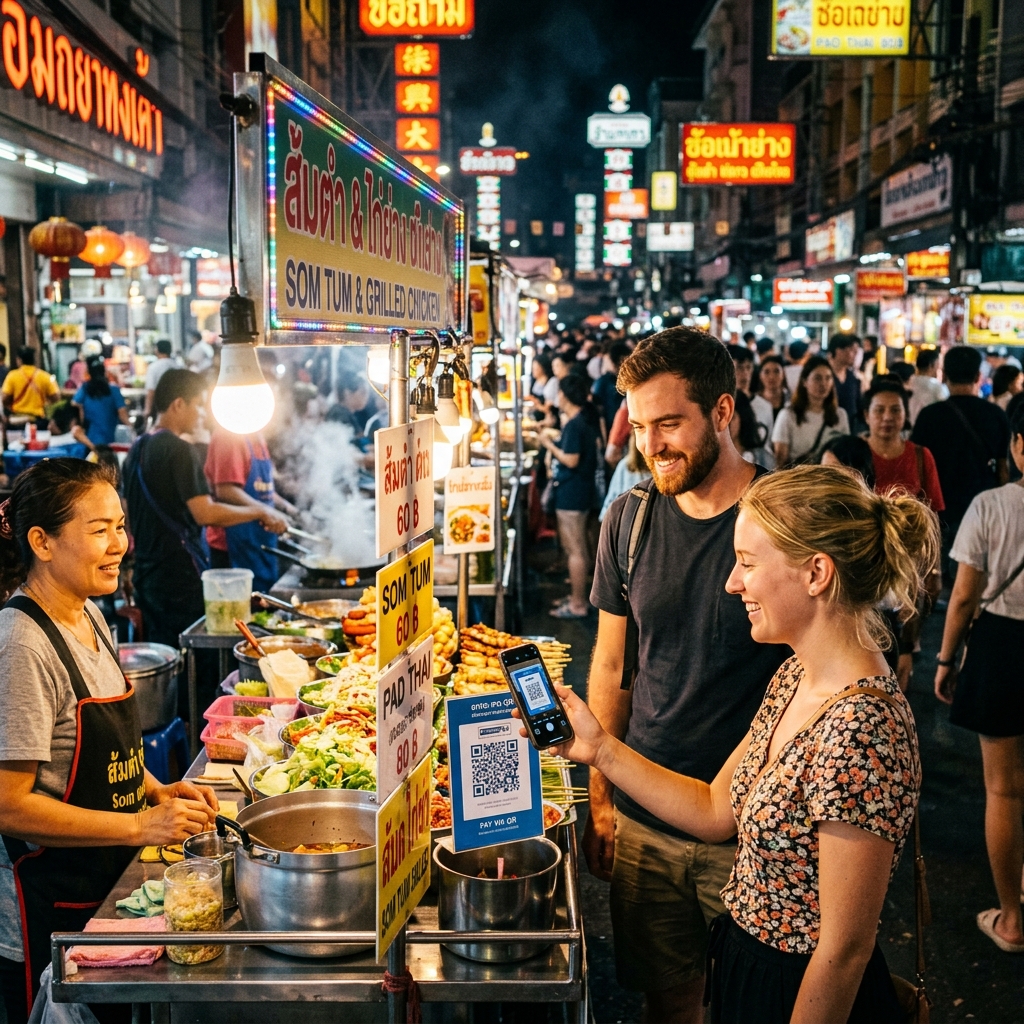
This is where Remitran comes in.
We realized that while Thailand was ready for a cashless future, the rest of the world’s banking systems were still stuck in the past. As a US or European traveler, your home banking app can’t scan a PromptPay QR. Your credit card often carries a 3% “foreign transaction fee.” And the local exchange booths? They never give you the mid-market rate.
Remitran is the bridge.
With Remitran, you can live like a local without the local bank account:
- Seamless Scanning: Open the Remitran app and scan any blue PromptPay QR code instantly.
- Home Currency Payments: Pay using your familiar home country payment methods (Bank transfer, UPI, or local wallets).
- Real-Time Rates: We show you the live, transparent exchange rate. No hidden markups. No “ATM fees.”
- Security: Your data is protected by bank-grade encryption, and you never have to carry large amounts of cash.
We are launching in September 2026 to ensure that whether you’re a digital nomad staying for a year or a honeymooning couple staying for a week, your money moves as fast as you do.
The Verdict: Why It’s Time to Look East
The shift toward Southeast Asia isn’t just about saving money. It’s about a higher quality of life. It’s about trading the “hustle culture” of the West for the “Sabai Sabai” (relaxed) lifestyle of the East.
Thailand offers a version of luxury that is inclusive, a version of history that is living, and a version of technology that is truly empowering. The Mediterranean will always have its charm, but for the modern traveler seeking value, safety, and a touch of the exotic, all roads now lead to Bangkok.
Join the revolution. Join the waitlist for Remitran and make your next Thai adventure completely cashless.
Sign up for early access at https://remitranglobal.com/
Sources & Further Reading
- Ministry of Tourism and Sports (Thailand): 2024-2025 Annual Tourism Report
- Statista: International Visitor Spending Trends in Southeast Asia
- Aviation A2Z: United Airlines and Delta Expansion into Bangkok Hubs
- Travel Off Path: Why Thailand is the #1 Destination for US Remote Workers
- Nomad List: The Economics of Living in Chiang Mai vs. Lisbon
- Bumrungrad International Hospital: The Rise of Medical Tourism in Thailand
