The QR Revolution: Why Southeast Asia is Outpacing the West in Cashless Payments
If you walk into a coffee shop in London or New York, you’ll likely see a sleek card terminal and perhaps a small sign saying “Venmo Accepted.” But if you walk into a bustling street market in Bangkok, Hanoi, or Jakarta, you’ll see something entirely different: a sea of blue, red, and green QR codes displayed on everything from high-end boutiques to the smallest cart selling grilled skewers.
Southeast Asia has not just adopted digital payments; it has leapfrogged the traditional credit card era entirely. While the US and Europe are still untangling a web of proprietary apps and plastic cards, Southeast Asia has built the world’s most efficient, interoperable, and inclusive payment infrastructure.
The Fragmented West: The Illusion of Digital Innovation
In the United States and Europe, we often think we are at the cutting edge of FinTech. We have Apple Pay, Google Pay, and Venmo. But when you look under the hood, most Western “innovation” is simply a digital wrapper around a 60-year-old credit card system.
- Venmo and Cash App (US): These are incredible for splitting a dinner bill between friends, but they are “closed-loop” systems. If you have Venmo and your friend has Cash App, you’re stuck. Moreover, while more merchants are accepting these apps, it’s far from universal. A street vendor in a US city is still much more likely to ask for “Cash Only” than to have a Venmo QR code ready.
- The “Apple Pay” Trap: Apple Pay is convenient, but it still relies on the Visa/Mastercard rails. This means merchants still pay 1.5% to 3.5% in transaction fees, and the money still takes days to settle in their bank accounts.
- The Digital Divide: Because Western systems are built on cards, they often exclude the “unbanked” or those without high credit scores. This is where the West has stalled while the East has accelerated.
The Unified East: National QRs and the Power of Open Rails
In Southeast Asia, the government and central banks took a different approach. Instead of letting tech giants build private walls, they built National QR Standards. They treated payment infrastructure like a public utility—like roads or water—rather than a private monopoly.
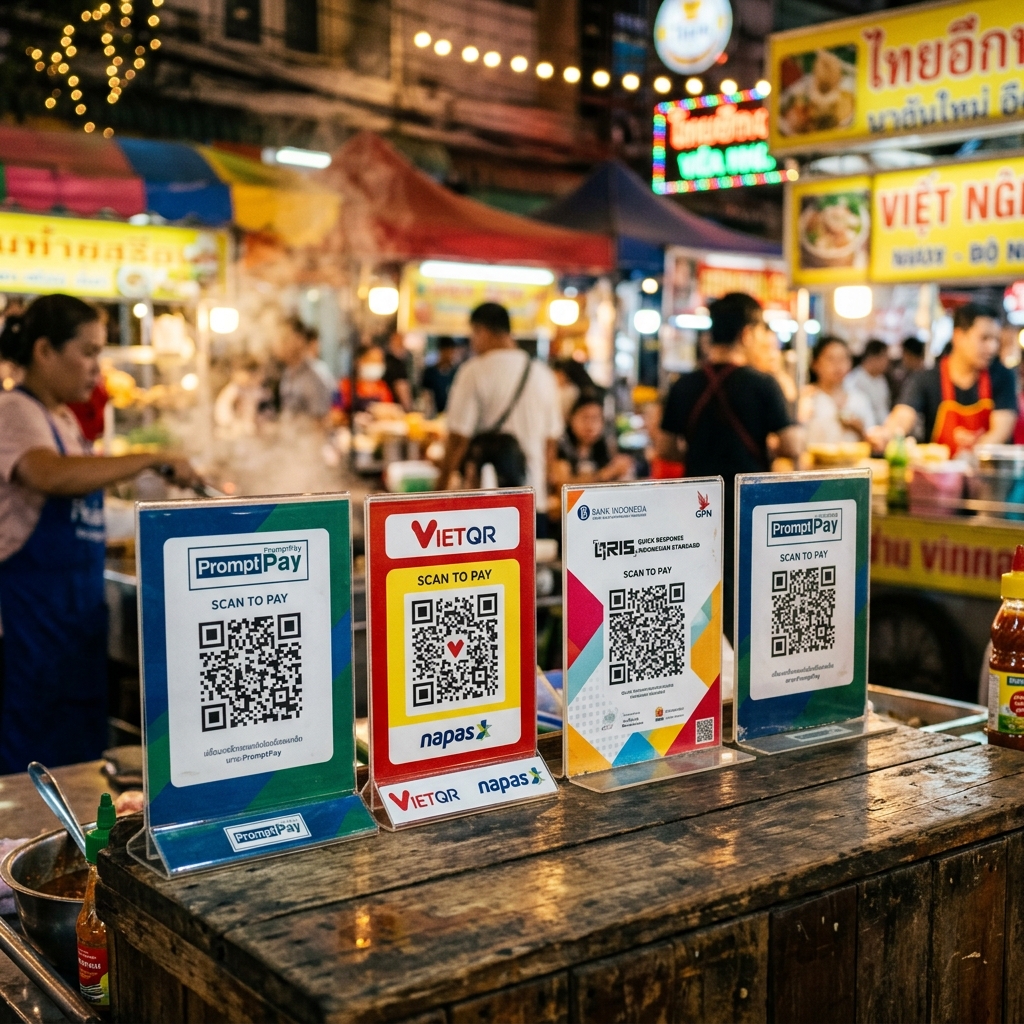
1. PromptPay (Thailand): The Gold Standard
Thailand’s PromptPay is arguably the most successful real-time payment system in the world.
- The Numbers: By late 2025, PromptPay had over 82 million registrations (in a country of 71 million people!) and was processing over 2.2 billion transactions monthly.
- The Impact: You can pay for a 50-cent stick of street food or a $5,000 diamond watch using the exact same QR code. The vendor receives the money instantly, and for transactions under 5,000 Baht, there are zero fees for the user.
2. VietQR (Vietnam): The Explosive Growth
Vietnam has seen an even more explosive growth by skipping the PC era and going straight to mobile.
- The Numbers: In 2024, QR transaction value in Vietnam surged by over 150%. By 2025, QR codes held more than 54% of the total mobile payment market share.
- NAPAS: The national payment gateway ensures that every bank in Vietnam can scan a VietQR, making it the primary way people move money, pay bills, and shop.
3. QRIS (Indonesia): The World’s Largest QR Network
Indonesia’s QRIS (Quick Response Code Indonesian Standard) has unified dozens of digital wallets (Gopay, OVO, Dana) into one single code.
- The Scale: Over 30 million merchants in Indonesia now accept QRIS, with the vast majority being micro-merchants and SMEs who previously could never afford a card terminal.
The Merchant Math: Why the “Little Guy” Wins in SEA
In the West, if a small street vendor wants to accept credit cards, they need:
- A hardware terminal (Cost: $100 - $300).
- A monthly subscription fee.
- To give up 3% of every sale to the bank.
In Southeast Asia, a vendor needs:
- A piece of paper. (Cost: 5 cents to print the QR).
- Zero monthly fees.
- Zero transaction fees (in most cases).
This economic shift has empowered millions of small businesses. It’s why you can buy a single coconut on a remote beach in Bali or a vintage shirt in a Bangkok night market without ever touching a physical coin.
The Next Frontier: Cross-Border QR Linkages
The most mind-blowing part of the SEA revolution isn’t just internal; it’s international. The ASEAN (Association of Southeast Asian Nations) central banks have begun linking their national QR systems.
- Thailand + Vietnam: A Thai tourist can now walk into a shop in Hanoi, scan a VietQR with their Thai banking app, and pay in Baht. The conversion happens instantly at the mid-market rate.
- Singapore + Malaysia: PayNow and DuitNow are now linked, allowing seamless cross-border transfers and merchant payments.
This is the future of global finance—a world where “currency exchange booths” are relics of the past.
Technical Leapfrogging: ISO 20022 and Real-Time Rails
While the West is bogged down by legacy COBOL systems and slow clearing houses, Southeast Asian nations built their systems on ISO 20022 standards and Real-Time Gross Settlement (RTGS) rails.
This means when you scan a QR code in Thailand:
- Your bank verifies the funds instantly.
- The Central Bank settles the transaction instantly.
- The merchant’s app pings with a “Payment Received” notification instantly.
There is no “pending” status. There is no “3-day clearing.” It is the speed of the internet applied to money.
Comparison: The Digital Payment Divide
| Feature | The West (US/EU) | Southeast Asia (SEA) |
|---|---|---|
| Primary Digital Tool | Credit/Debit Cards (NFC) | Standardized QR Codes |
| Vendor Acceptance | High for shops, Low for street level | 100% Ubiquity (Mall to Street) |
| Settlement Speed | 1–3 Business Days | Instant (Real-time) |
| Merchant Fees | 1.5% – 3.5% | 0% – 1% (Often free for small vendors) |
| Interoperability | Fragmented (Venmo vs Cash App) | Unified (National Standards) |
| Cross-Border Use | Expensive & Manual | Seamless & Integrated (ASEAN Link) |
| Hardware Required | Expensive Card Terminals | Zero (Just a printed QR code) |
Remitran: Bringing the 22nd Century to Your Wallet
This brings us to the “Digital Divide” that Western travelers face. When you land in Bangkok or Jakarta, you are entering a high-tech financial paradise, but your Western tools are outdated.
- Your Venmo doesn’t work abroad.
- Your Bank App can’t read a PromptPay QR.
- Your Credit Card is rejected by the street vendor who only takes QR.
You are forced back into the 20th century: carrying cash, paying high ATM fees, and worrying about lost wallets.

Remitran is the bridge.
We are the first platform designed to connect Western banking protocols to the real-time QR rails of Southeast Asia. With Remitran, you can live like a local:
- Universal Access: Scan any PromptPay, VietQR, QRIS, or PayNow code.
- Home Funds: Pay using your familiar US or European bank accounts.
- Fair Exchange: Get the real-time, mid-market exchange rate without the “tourist tax.”
- Security: No more carrying wads of cash. Your payments are protected by the same security as your home bank.
We are launching in September 2026 to ensure that the cashless revolution isn’t just for locals—it’s for everyone.
The world is moving toward a unified, real-time financial future. Southeast Asia is leading the way, and Remitran is making sure you aren’t left behind.
Sign up for the waitlist at https://remitranglobal.com/
Sources & Data Points
- Bank of Thailand (BOT): Payment Systems Report - Nov 2025 Statistics
- State Bank of Vietnam (SBV): Annual Report on Non-Cash Payment Growth
- Bank Indonesia (BI): QRIS Adoption and SME Empowerment Study 2025
- Monetary Authority of Singapore (MAS): The Connectivity of ASEAN Payment Systems
- World Bank: The Global Findex Database - Digital Payments in Emerging Markets
- Statista: Comparison of POS Payment Methods: North America vs. APAC 2025
- FinTech News Singapore: The Rise of Cross-Border QR Payments in ASEAN